
Hootsuite and buffer are two competent social media marketing and management tools. Both promises amazing automation and reporting features.
But they’re built for very different people. Buffer targets solo creators and small teams. Hootsuite targets agencies and enterprise marketing departments, and its pricing shows it.
This guide breaks down both tools specifically for solopreneurs.
Know what you’re actually paying for and what you’ll actually use.
Table of Contents
Buffer vs Hootsuite: Quick Comparison Table
| Feature | Buffer | Hootsuite |
| Free plan | Yes, 3 channels, 10 posts each | No, 14-day trial only |
| Starting price | $5/channel/month (Essentials, annual) | $99/user/month (Standard, annual) |
| Pricing model | Per channel | Per user (seat) |
| Best for | Solo creators, freelancers, 1-3 person teams | Agencies, marketing teams, 5+ people |
| AI assistant | Yes, included on all plans | Yes, on paid plans |
| Analytics | Built-in Insights, available on free plan | Deeper analytics, locked to higher tiers |
| Social listening | No | Yes, on Advanced and up |
| Approval workflows | Yes, on Team plan | Yes, on Advanced plan |
| Learning curve | Low | Moderate to steep |
| Supported networks | Instagram, TikTok, LinkedIn, Facebook, X, Threads, Pinterest, YouTube, Bluesky, Mastodon | Instagram, TikTok, LinkedIn, Facebook, X, Pinterest, YouTube |
Both tools are two of the best social media scheduling tool for solo businesses.
If you’re a solopreneur juggling three or four channels, Buffer costs a fraction of Hootsuite for nearly the same core workflow.
But Hootsuite provides access to some advance options.
What Buffer Offers Solopreneurs
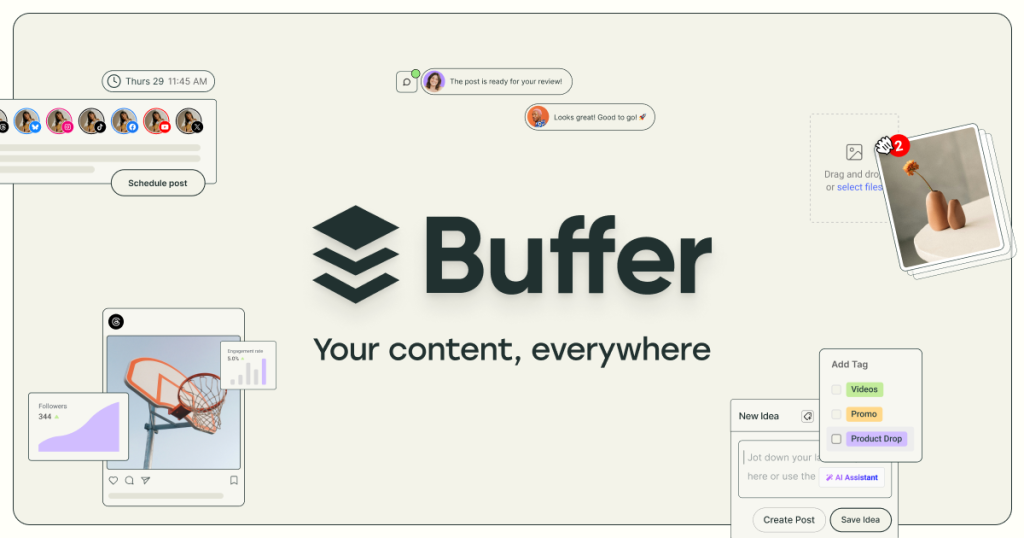
Buffer was built around one idea. Scheduling should be simple. That focus shows in everything from its dashboard to its pricing.
Buffer Pricing
Buffer’s free plan covers 3 channels with 10 scheduled posts each. That’s enough to test the platform before spending anything.
Paid plans are priced per channel, not per user. Essentials runs $5 per channel per month on annual billing, or $6 monthly. Team runs $10 per channel per month annually, or $12 monthly.
For a solopreneur managing three channels, that’s roughly $180 a year on Essentials. Compare that to Hootsuite’s cheapest plan, and the gap is dramatic.
Buffer Features
Buffer’s free tier includes an AI assistant for content generation, a landing page builder, and basic 30-day analytics. Paid tiers add unlimited scheduling and longer analytics history.
Buffer’s newer analytics system, called Insights, launched in 2026 and pulls post-level performance across ten-plus networks into one dashboard. It’s available even on the free plan, which is rare for this category.
Buffer also supports Mastodon and Bluesky alongside the usual major networks. If you’re experimenting with newer platforms, that matters.
Bottom line: Buffer gives you real functionality on its free plan. You won’t feel pressured into paying before you’re ready.
What Hootsuite Offers Solopreneurs
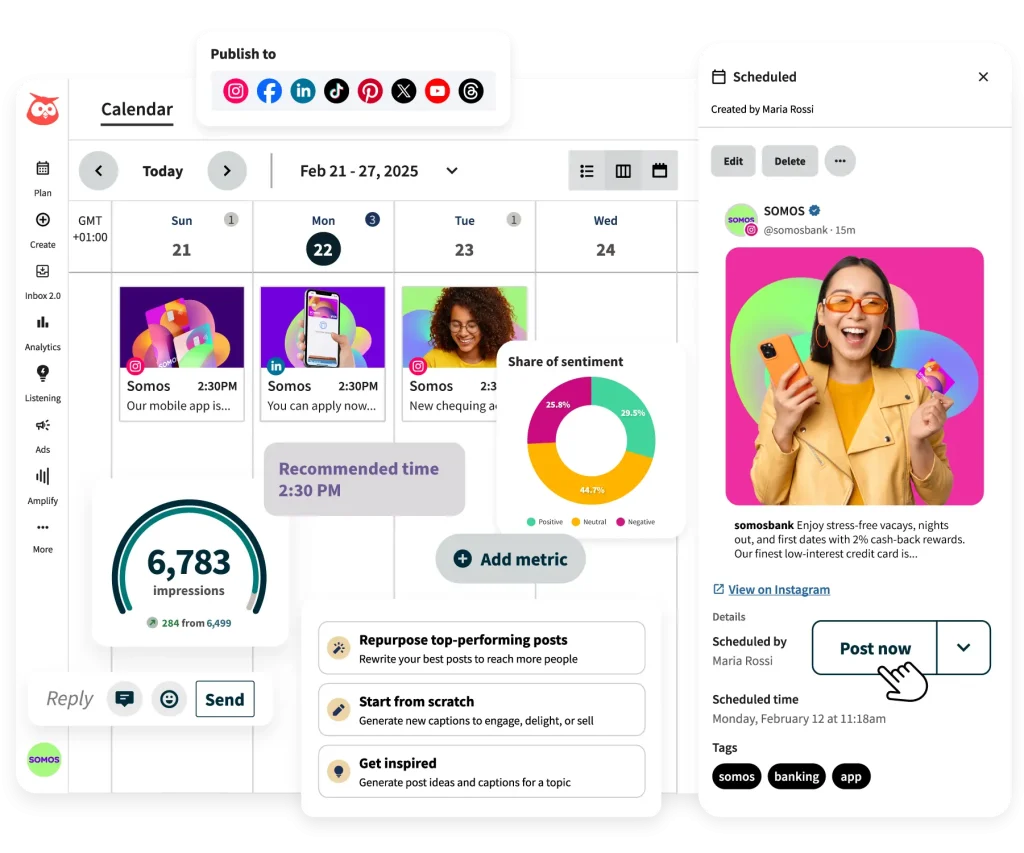
Hootsuite built its name on depth. It’s the tool agencies reach for when they’re managing dozens of client accounts at once.
Hootsuite Pricing
Hootsuite’s plans start at $99 per user per month, based on annual billing. A 14-day free trial is available without a credit card, but there’s no permanent free plan.
Because Hootsuite sells seats, you pay per person, not per channel. As a solo user, that’s less painful. The moment you bring on a contractor or VA, though, your bill jumps.
Published pricing for the next tier lands around $199 to $249 per user per month annually, based on multiple current pricing breakdowns. Confirm the exact figure on Hootsuite’s pricing page before committing, since published tiers shift.
Hootsuite Features
Hootsuite’s dashboard is built for volume. It handles bulk scheduling, deeper reporting, and social listening once you move past the entry tier.
Hootsuite offers broader social network support, more sophisticated analytics and reporting, and dedicated team collaboration features that Buffer’s lower tiers don’t match. But that power comes with a steeper learning curve.
Several reviewers describe Hootsuite’s interface as dated and overwhelming for new users, especially after the platform dropped its free tier. For a solo operator without a marketing background, that’s real friction.
Bottom line: Hootsuite’s extra features matter for teams managing many clients. For one person handling three or four channels, most of that power sits unused.
Pricing Head-to-Head: The Real Gap
This is where the decision usually gets made. The pricing logic between these two platforms couldn’t be more different.
Buffer charges per channel, in the range of $5 to $10 a month, while Hootsuite charges per user, starting around $99 to $249 a month. That structural difference favors solopreneurs almost every time.
At the low end, the annual cost gap runs roughly $180 for Buffer versus over $2,000 for Hootsuite, a gap researchers peg at more than ten times the price for similar core scheduling functionality.
Hootsuite only starts to make financial sense once you need capabilities Buffer doesn’t offer. Think social listening, ad management, or deep competitor benchmarking.
Bottom line: For pure scheduling and publishing, Buffer wins the price comparison decisively at solopreneur scale.
Ease of Use: Which One Fits a One-Person Workflow
You don’t have time to learn a complicated system. Every hour spent in a dashboard is an hour not spent on client work.
Buffer’s interface is built around simplicity first. Most users are scheduling their first post within minutes of signing up.
Hootsuite’s interface reflects its enterprise roots. It has more menus, more settings, and more configuration than a solopreneur typically needs.
Bottom line: If ease of use matters more to you than advanced reporting, Buffer is the lower-friction choice.
When Hootsuite Actually Makes Sense for a Solopreneur
Buffer wins for most one-person businesses, but not all. If you’re managing accounts for multiple clients as a freelance social media manager, Hootsuite’s bulk tools can save real time.
Hootsuite fits users who need social listening, combined paid and organic analytics in one report, a unified inbox, and approval workflows, plus the budget to support enterprise software.
If none of that applies to you yet, you’re paying for capacity you won’t use.
Bottom line: Choose Hootsuite only if your business has already outgrown simple scheduling and you can justify the cost.
Key Takeaways
- Buffer’s free plan covers 3 channels and is a genuine starting point, not a limited demo.
- Buffer prices per channel, starting at $5/month on Essentials with annual billing.
- Hootsuite has no permanent free plan and starts at $99/user/month annually.
- Hootsuite’s pricing model punishes solopreneurs who bring on even one collaborator.
- Buffer’s Insights analytics are available on the free plan, unlike most competitors.
- Hootsuite makes sense once you need social listening, ad management, or agency-scale reporting.
- For a typical solopreneur managing 1-5 channels, Buffer is the more practical and affordable pick.
Frequently Asked Questions
Q1. Is Buffer really free for solopreneurs, or are there hidden limits?
Buffer’s free plan covers 3 channels with 10 scheduled posts per channel. It includes basic analytics and an AI assistant, with no time limit on the free tier itself.
Q2. Does Hootsuite offer any discount for solo users or freelancers?
Hootsuite doesn’t publish a solopreneur-specific discount. Its cheapest published plan starts around $99 per user per month on annual billing, with occasional promotional trials.
Q3. Which tool is easier to learn with no marketing background?
Buffer is generally easier to learn. Its dashboard is built around straightforward scheduling, while Hootsuite’s broader feature set adds a steeper learning curve.
Q4. Can I switch from Hootsuite to Buffer without losing my scheduled posts?
Most switches require manually rebuilding your queue, since these platforms don’t offer direct migration tools. Export your content calendar first, then reconnect your channels in Buffer before canceling Hootsuite.
Pricing reflects publicly available information as of August 2026. Confirm current rates on each provider’s official pricing page before purchasing, since tiers and prices change.